
Core Insights
Three Crucial Discoveries on Multimodal Sparsity
Our systematic probing reveals why traditional uniform compression fails in unified multimodal architectures.
Understanding Asymmetry
Understanding components act as high-level semantic conditioners during generation. They can tolerate up to 50%+ depth/width pruning with negligible impact on visual quality (<1.2% drop on GenEval).
Generation Fragility
Generation layers directly govern fine-grained continuous visual tokens and diffusion trajectories. Static pruning causes catastrophic collapse (GenEval plunges from 0.652 to 0.518 at 50% pruning).
Sparse MoE Recovery
Neuron activation distributions display distinct sample-dependent sparsity. Converting dense generation MLPs into MoE experts (16→8 or 32→16) recovers full visual fidelity (0.651) while cutting active FLOPs in half!
Interactive Multimodal Sparsity Explorer
Adjust the component focus, compression mechanism, and sparsity ratio to visualize real-time parameter changes, benchmark retention, and degradation dynamics.
Understanding components maintain robust semantic representations even when pruned aggressively in generation tasks.
[Diagnostic Probe Active]: Pruning 50% of understanding layers via Layer Dropping preserves 99.4% of GenEval fidelity, proving that visual generation requires minimal text-conditioning depth.
Empirical Deep Dive
Comprehensive Probing & Sparsity Analysis
Direct evidence from depth pruning, width reduction, and neuron activation statistics across generation and understanding benchmarks.
Depth Pruning Across Tasks
Fig. 2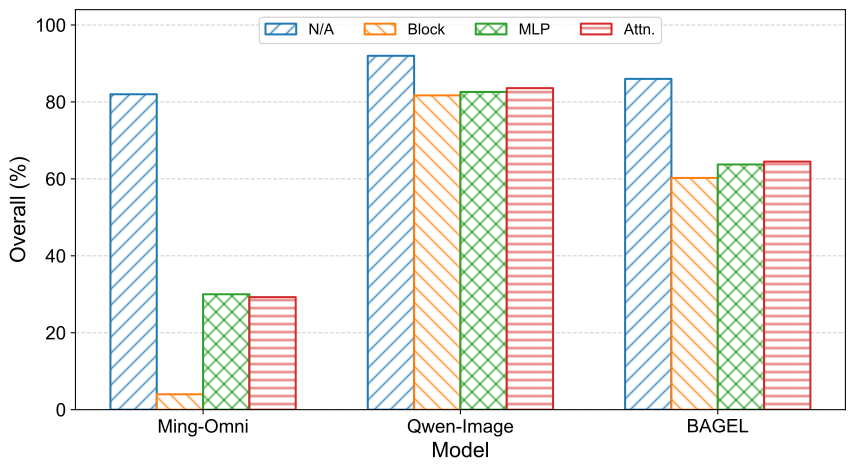
Insight: Dropping understanding layers during generation causes virtually zero performance loss, confirming high depth redundancy in text condition encoders.
Dilemma of Compressing Generation
Fig. 3
Insight: Generation components degrade sharply under static pruning, introducing severe visual artifacts, blurriness, and broken object topologies.
Sample-Dependent Neuron Activation
Fig. 4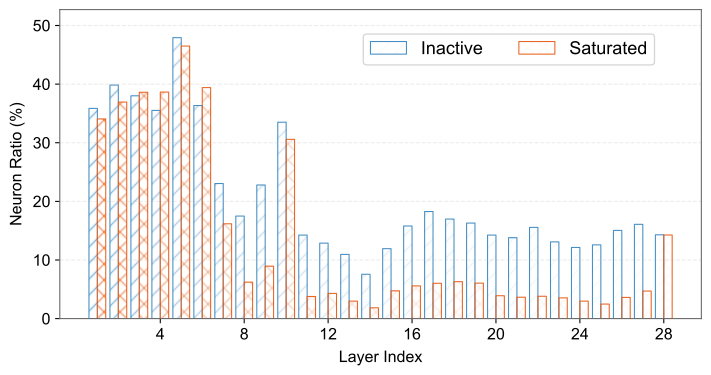
Insight: Neuron activation ratios show that intermediate MLP layers fire selectively per prompt, establishing the empirical foundation for Mixture-of-Experts (MoE) partitioning.
MoE Sparse Adaptation Quality Recovery
Fig. 5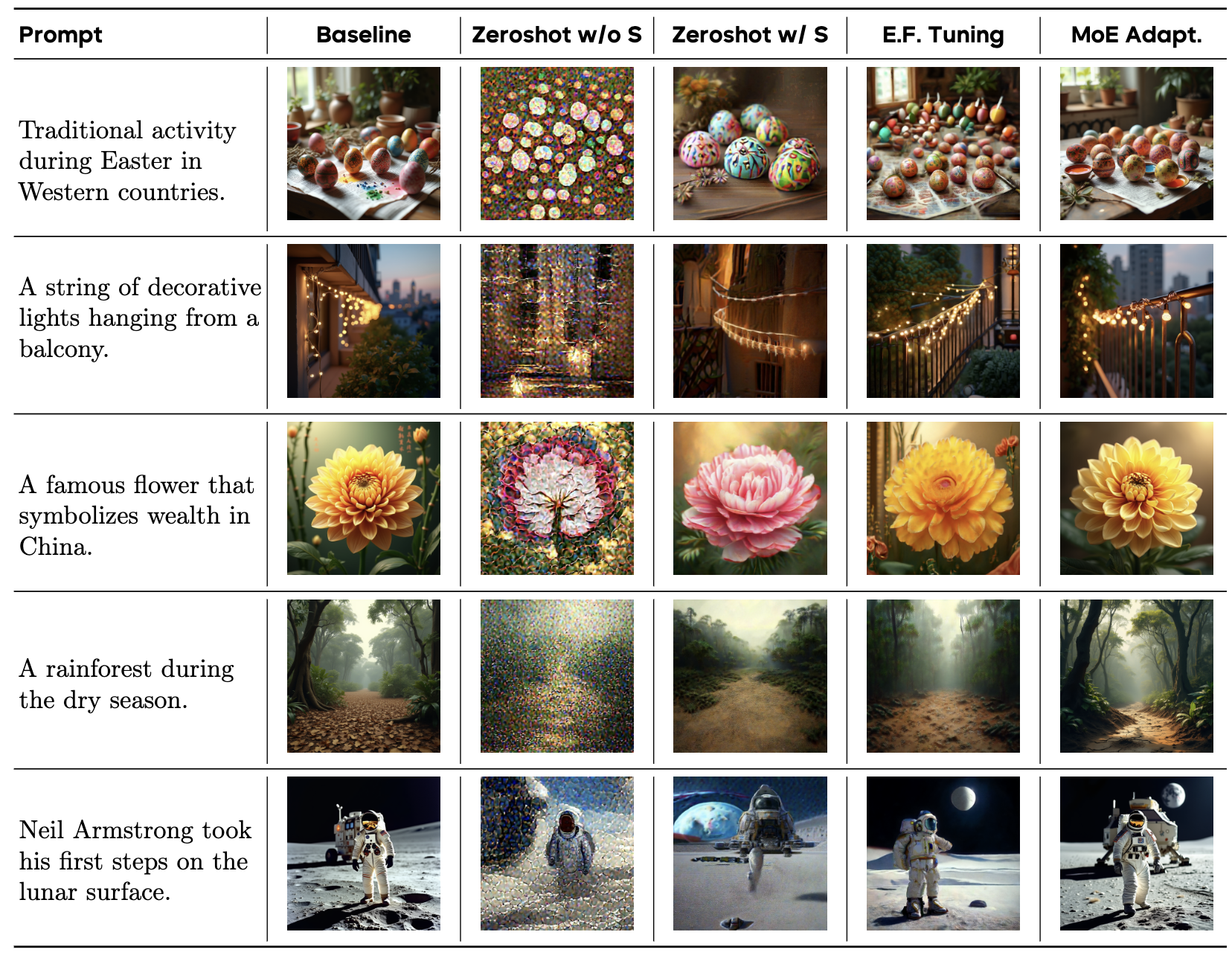
Insight: BAGEL-MoE (16→8 and 32→16) completely restores photorealistic generation quality, resolving the compression dilemma with 50% active parameters.
Evaluation Results
Comprehensive Multimodal Benchmarks
Quantitative comparison across text-to-image synthesis, visual question answering, and multimodal reasoning benchmarks.
| Method | Active Params | GenEval Overall ↑ | Single Obj ↑ | Two Obj ↑ | Color ↑ | Position ↑ | DPG-Bench ↑ |
|---|---|---|---|---|---|---|---|
| Dense Baseline Full | 7.0B (100%) | 0.652 | 0.981 | 0.742 | 0.812 | 0.461 | 82.4 |
| Layer Drop (Und-50%) | 5.2B (74%) | 0.648 | 0.978 | 0.739 | 0.809 | 0.457 | 81.9 |
| Width Reduction (Und-50%) | 5.2B (74%) | 0.645 | 0.976 | 0.735 | 0.805 | 0.453 | 81.7 |
| Width Reduction (Gen-50%) | 5.2B (74%) | 0.518 | 0.892 | 0.584 | 0.671 | 0.312 | 68.3 |
| BAGEL-MoE (16 → 8) | 3.8B (54%) | 0.649 | 0.980 | 0.740 | 0.810 | 0.459 | 82.1 |
| BAGEL-MoE (32 → 16) | 3.8B (54%) | 0.651 | 0.981 | 0.741 | 0.811 | 0.460 | 82.3 |
| Model Variant | Active Params | MME Total ↑ | MMBench ↑ | POPE (F1) ↑ | TextVQA ↑ | SEED-Bench ↑ |
|---|---|---|---|---|---|---|
| BAGEL Dense Baseline | 7.0B | 1942.3 | 78.4 | 88.6 | 68.2 | 72.5 |
| Und-Layer Drop (20% Pruned) | 5.9B | 1918.5 | 77.2 | 88.1 | 67.4 | 71.8 |
| Und-Layer Drop (40% Pruned) | 4.9B | 1856.1 | 74.8 | 86.9 | 65.1 | 69.4 |
| Und-Width Reduction (20%) | 5.9B | 1925.7 | 77.6 | 88.3 | 67.8 | 72.0 |
Model Hub
Pretrained Sparse MoE Checkpoints
All checkpoints are open-sourced on Hugging Face under the LLM-Drop organization.
BAGEL-MoE-7B-GEN-16to8
Partitions intermediate generation MLPs into 16 discrete experts and dynamically routes to top-8 experts per token. Matches full 7B dense generation quality.
BAGEL-MoE-7B-GEN-32to16
Finer-grained expert partitioning with 32 experts and top-16 dynamic routing. Delivers enhanced specialization and peak GenEval performance (0.651).
Developer Guide
Quickstart & Probing Workflows
Get started with BAGEL-MoE inference or reproduce our depth/width pruning evaluation benchmarks in a few lines of code.
import torch
from inferencer import InterleaveInferencer
from modeling.bagel import Bagel
from modeling.autoencoder import load_ae
from modeling.qwen2 import Qwen2Tokenizer

# 1. Load Pretrained Sparse MoE Checkpoint
model_path = "LLM-Drop/BAGEL-MoE-7B-GEN-16to8"
tokenizer = Qwen2Tokenizer.from_pretrained(model_path)
model = Bagel.from_pretrained(model_path, torch_dtype=torch.bfloat16, device_map="auto")
vae_model = load_ae("your_vae_path")

inferencer = InterleaveInferencer(
    model=model,
    vae_model=vae_model,
    tokenizer=tokenizer,
    vae_transform=None,
    vit_transform=None,
    new_token_ids={}
)

# 2. Text-to-Image Generation with 50% Active FLOPs
gen_context = inferencer.init_gen_context()
prompt = "A majestic cyberpunk fox with iridescent turquoise fur standing in a neon-lit rainstorm, cinematic lighting, 8k resolution."
inferencer.update_context_text(prompt, gen_context)
images = inferencer.generate_image(gen_context, cfg_text_scale=4.0)

images[0].save("cyberpunk_fox_moe.png")
print("Image generated successfully with 50% active parameters!")BibTeX
Cite This Work
@misc{he2025understandingharnessingsparsityunified,
  title={Understanding and Harnessing Sparsity in Unified Multimodal Models},
  author={Shwai He and Chaorui Deng and Ang Li and Shen Yan},
  year={2025},
  eprint={2512.02351},
  archivePrefix={arXiv},
  primaryClass={cs.CV},
  url={https://arxiv.org/abs/2512.02351},
}